
Blue Gate (Bab Boujloud Fez) Old Fez, The Main Gate of Fes el Bali
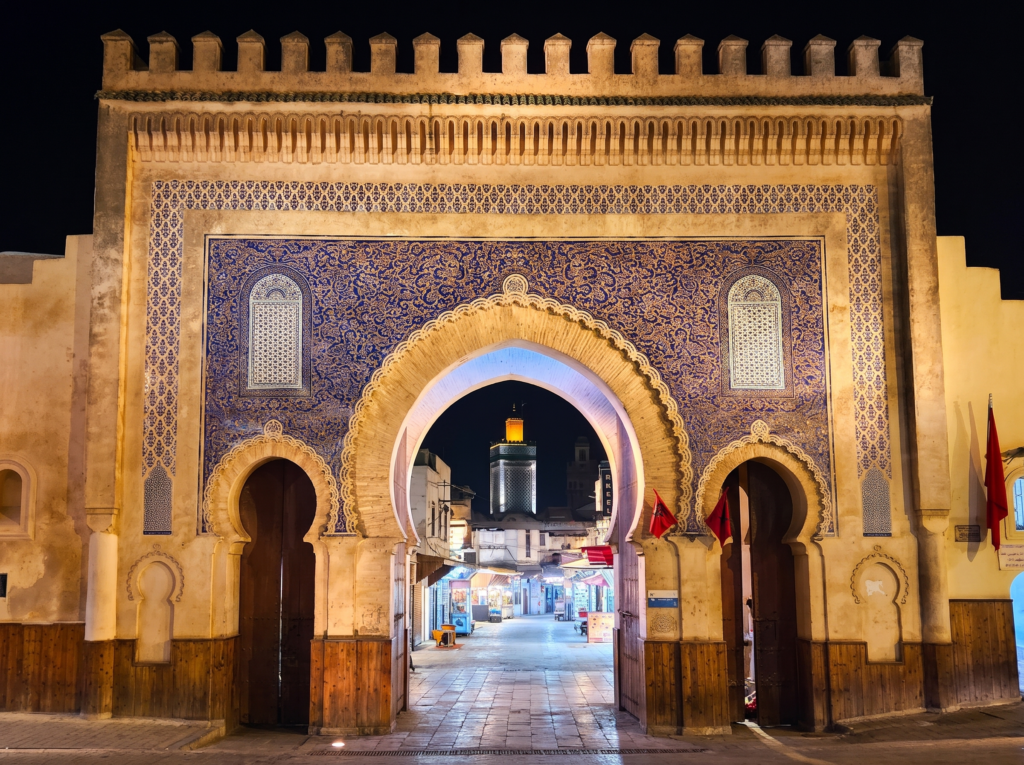
If you are exploring Fez, the Blue Gate is an easy-to-recognize threshold between the city and its old medina. Zellige means glazed tilework arranged in decorative patterns, and its color catches your eye before you enter. You can pause on the square, watch people pass, and decide whether to step into the maze of lanes. The entrance gives you a clear landmark in a city where narrow streets can quickly feel unfamiliar.
The gate has two differently colored faces, one toward the square and one toward the medina. That contrast makes it worth turning around after you pass through. You do not need a long visit to enjoy the view, but the nearby streets invite you to stay. Its appeal is not only the striking entrance, but also the lively streets that begin just beyond it.
Key Takeaways
- Bab Boujloud is the western entrance to Fes el-Bali.
- You can walk through for free at any hour.
- Place Boujloud is the square outside the entrance.
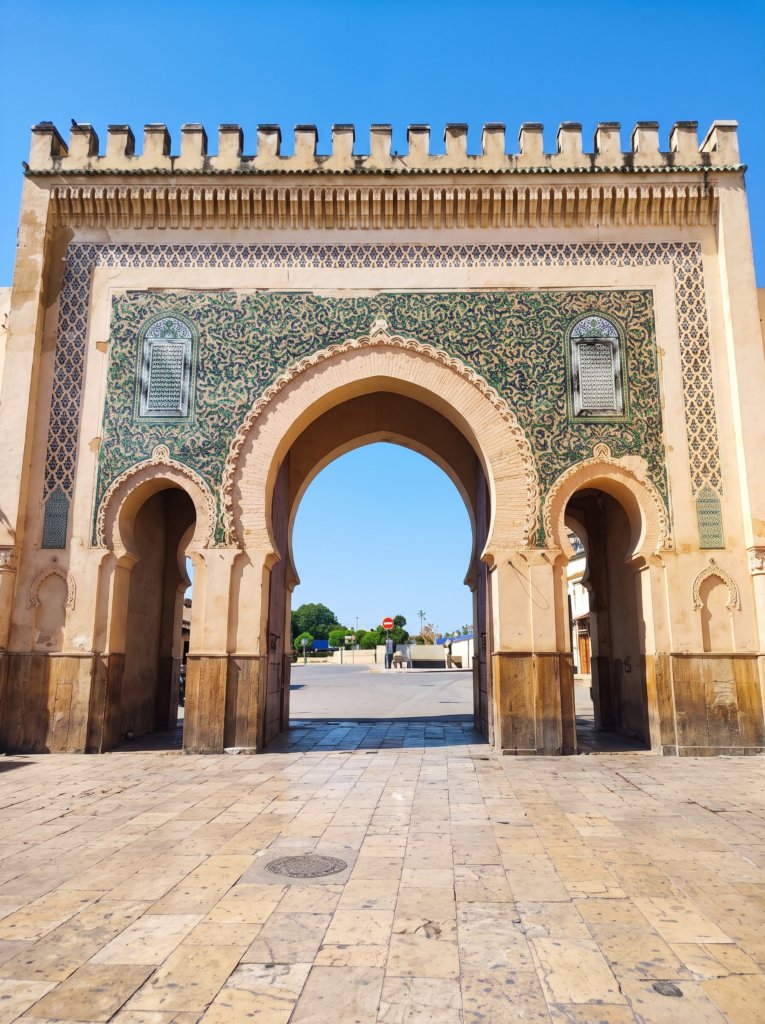
- The square-facing side is blue; the medina-facing side is green.
- Talaa Kebira and Talaa Seghira start just inside the gate.
- Turn back after entering to see the green face.
What should you know before visiting Blue Gate Fez?
You can walk through Bab Boujloud for free at any hour, so you do not need a ticket or a timed visit. The open access makes it an easy stop during a trip through the city.
Fes el-Bali, the old medina, has been a UNESCO World Heritage Site since 1981. That designation applies to Fes el-Bali, not just to the gateway. The square outside the entrance is called Place Boujloud and is also known as Place Pacha el-Baghdadi.
Fes el-Bali has held UNESCO World Heritage status since 1981.
Use this short list to get your bearings before you step into the old medina:
- Entry: Walking through the gate costs nothing.
- Hours: The passage is accessible at any hour.
- Square: Place Boujloud is also called Place Pacha el-Baghdadi.
- Position: The gate stands at the western entrance to Fes el-Bali.
The square is a useful place to pause before entering the lanes. It offers a broad view of the entrance and makes a clear meeting point in a busy area.
Because the passage stays open, you can visit before breakfast or later in the day without planning around an admission desk. Shops and cafes nearby follow their own schedules.
Use Place Boujloud as your meeting point if you are arranging to meet someone nearby.
How did the present gate differ from the medieval entrance?
The monumental entrance is a 1913 gateway, while the older, closed passage beside it is thought to date mainly from the 12th century. The two structures served different roles in the city’s defenses and daily movement.
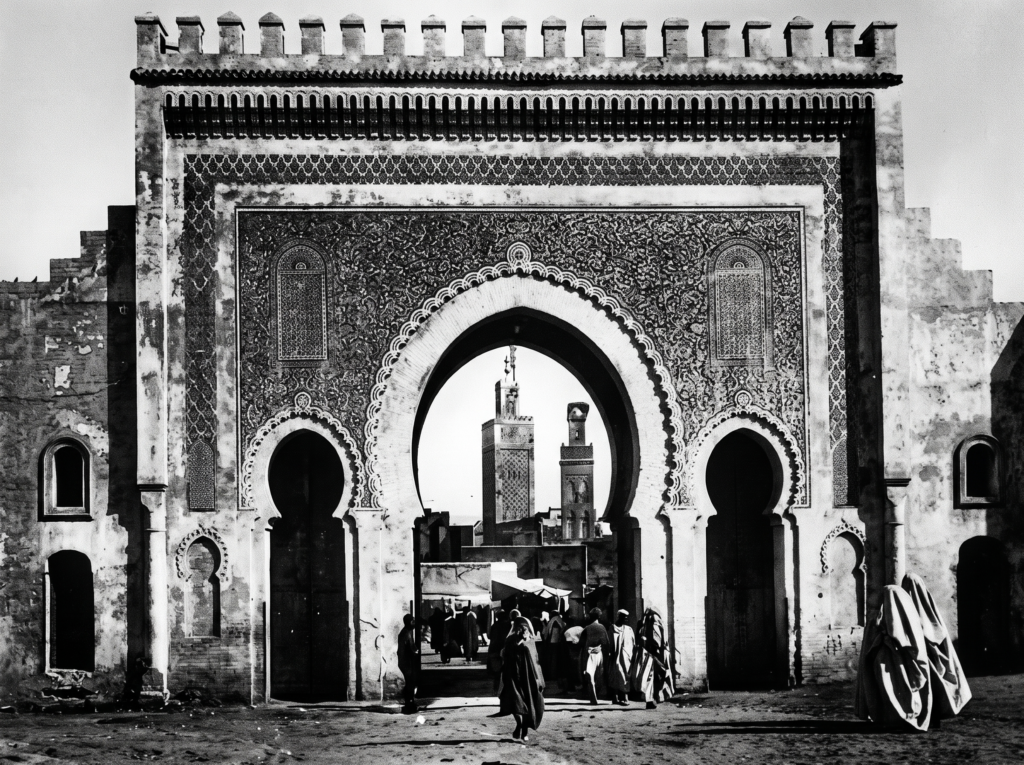
Fes has had walls since the 8th century, and its ramparts stretch for nearly 20 kilometers. Idrisid, Almoravid, Almohad, and Marinid rulers each helped shape the walls and gates as the city grew.
The older gate’s passage bends and runs parallel to the wall. A person using it would emerge sideways into Tala’a Kebira, rather than walking straight through a grand opening.
The older defensive passage
The older gate stands closed beside the current entrance. Its bent design helped protect the approach, since a direct route through a wall could be easier to enter quickly.
Its likely 12th-century date places it among the older defenses of Fes el-Bali. It belongs to a longer story of walls built and changed across several centuries.
The 1912 plan and 1913 opening
Captain Mellier drew up plans for a new gateway in December 1912. The work required the purchase and demolition of a stable and three shops owned by a religious endowment.
France established its protectorate in 1912, and the present gate was completed the following year. The monumental entrance visitors use today is therefore a 1913 structure, not a 12th-century gate.
The older passage remains a separate feature beside it, even though it no longer serves as the way into the medina. From the square, look to the left of the present entrance to spot the older gate.
What makes Bab Boujloud’s architecture distinctive?
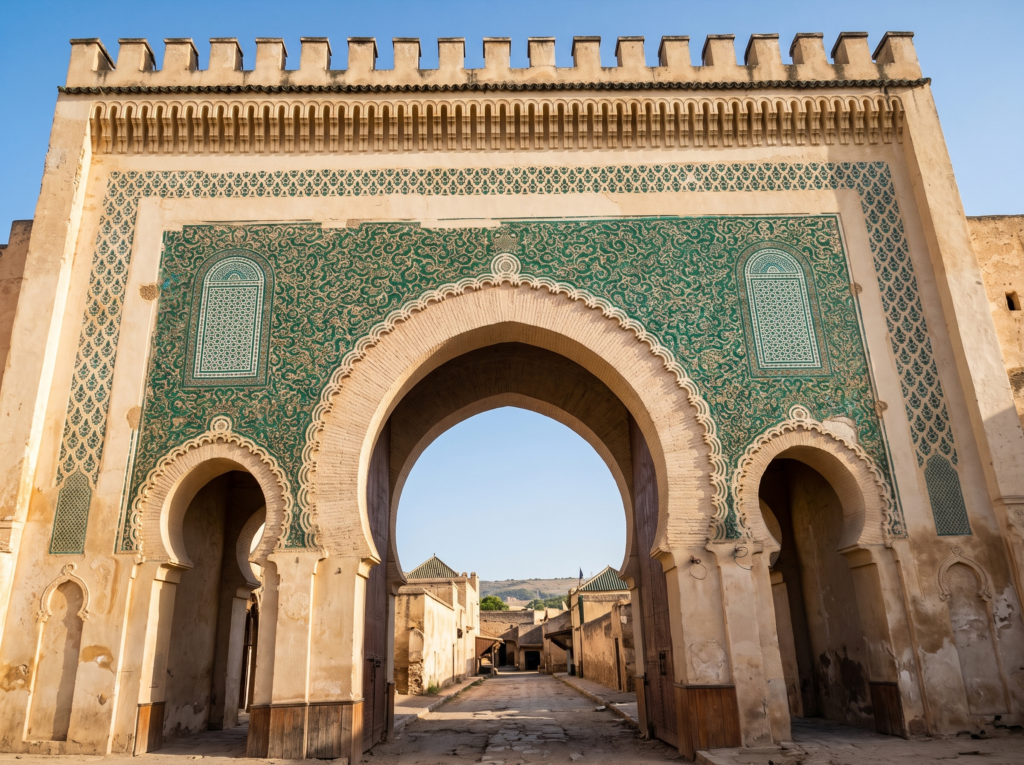
Begin by looking at the three pointed horseshoe arches, with the largest passage in the middle. Their balanced shape gives the gateway a clear center, even when people fill the square.
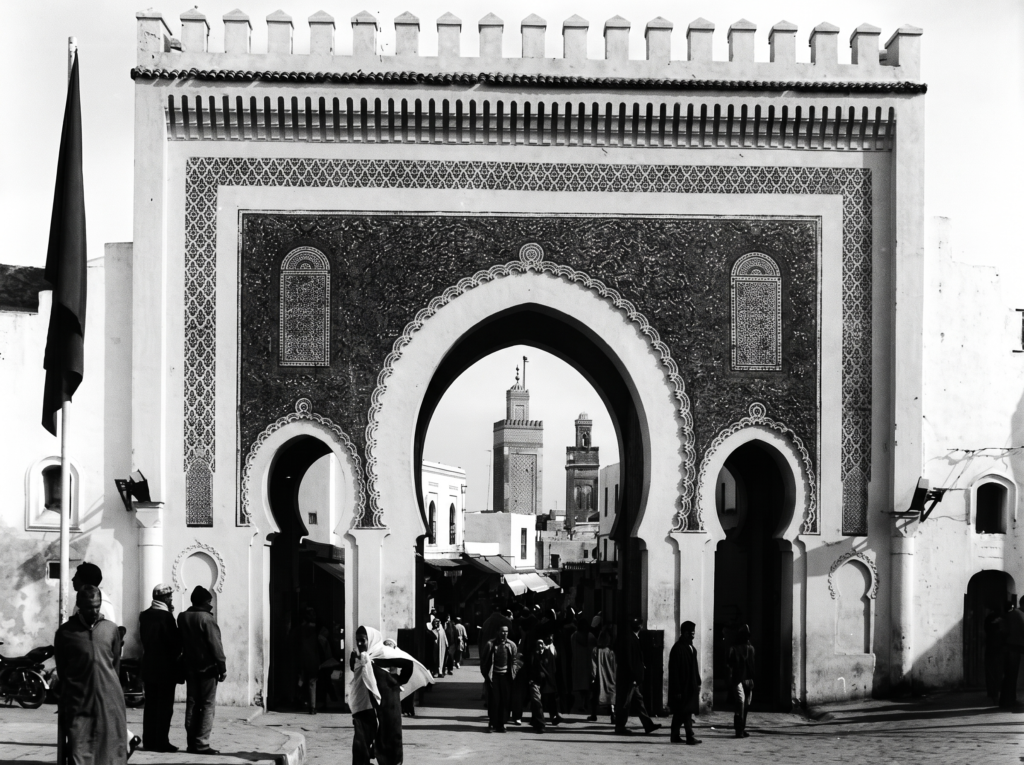
The two side passages are smaller, but they repeat the same pointed horseshoe form. Look above the arches for the tile patterns, scalloped moulding, blind windows, and crenellations.
| Feature | Position | What to notice |
|---|---|---|
| Central arch | Middle | One large, pointed horseshoe arch |
| Side arches | On both sides | Two smaller, pointed horseshoe arches |
| Upper wall | Above the arches | Geometric and floral glazed tiles, scalloped moulding, two blind windows, and crenellations |
The main opening is wide and tall, while the smaller passages frame it on either side. That change in scale draws your eye toward the center of the facade.
On the upper wall, geometric and floral patterns sit among the raised scalloped lines around the arches. The blind windows above the side passages are decorative openings, not routes through the wall.
The crenellations form a notched edge along the top. They give the broad facade a strong outline against the sky, especially when you view it from across Place Boujloud.
Step back far enough to see the arches and crenellated top as one composition.
Why are the two sides of the gate different colors?
The gate is blue on the side facing the square and green on the side facing the medina. The color shift becomes easy to miss if you only look from one direction.
Blue is traditionally explained as representing Fez, while green is traditionally linked with Islam. That explanation is familiar, but no published 1913 text confirms that the builders intended those meanings.
| Face | Predominant color | Traditional explanation |
|---|---|---|
| Square-facing side | Blue | Traditionally associated with Fez |
| Medina-facing side | Green | Traditionally associated with Islam |
| Symbolism caveat | Not confirmed | No published 1913 text confirms the intended meaning |
The colors help distinguish the two faces, but they do not prove what the people who planned the gate meant. Treat the familiar explanation as a tradition rather than a documented statement of intent.
The green facade is often backlit, which can make its details harder to see from the medina side. The view is still worth seeking out, especially after you have passed through the central opening.
After walking through, turn back toward the entrance to see its less-seen green face.
When is the best time to see Bab Boujloud?
Choose sunrise or early morning if your priority is seeing the medina’s buildings with fewer people around. The quietest stretch comes before shops open and tour groups arrive.
Early visits suit people who want calm streets and a clear view of the architecture. Late afternoon is another good time, though it may still be busy. That timing is a practical choice, not a promise of empty lanes.
Use these time scenarios to match your visit to what you want to see:
- Sunrise: Streets can be largely deserted, giving you a quiet look at the buildings.
- Early morning: Visit before shops open and tour groups reach the medina.
- 9 AM: Tour groups may gather to photograph Bou Inania’s minaret through the central arch.
- Late afternoon: The owner’s suggested time offers another chance to see the gate and square.
A sunrise visit feels different from a later stop. You can hear the city waking up before the busiest foot traffic fills the lanes.
At 9 AM, groups may cluster around the entrance for a framed view of Bou Inania’s minaret. That scene can make the central arch harder to photograph without people in it.
Late afternoon brings more activity around the square, but it can still work well if you enjoy a lively setting. Plan around the kind of visit you want, not just the clock.
If photographing the central arch matters to you, arrive before tour groups gather around it.
Which streets begin just inside the gate?
The two main streets start just behind Bab Boujloud and both lead downhill toward the Qarawiyyin quarter. Your first turn can help you get oriented before smaller lanes branch away.
Talaa Kebira crosses the medina toward al-Qarawiyyin Mosque, while Talaa Seghira heads east and joins narrower streets. Both routes are starting points, not simple paths through every alleyway.
These three points can help you choose a direction without trying to memorize the whole medina:
- Shared start: Talaa Kebira and Talaa Seghira begin just behind the gate.
- Talaa Kebira: It crosses the medina toward the Qarawiyyin quarter and al-Qarawiyyin Mosque.
- Talaa Seghira: It runs east and joins the medina’s narrower streets.
The names look similar, so take a moment to check which street you have joined. Each can lead toward more lanes, shops, and turns than you might expect.
Talaa Kebira offers the more direct sense of a main route across the medina. It continues toward the Qarawiyyin quarter and eventually reaches the mosque.
Talaa Seghira heads east, then gives way to a tighter network of streets. A map or local guide can help if you need to reach a precise address.
Choose Talaa Kebira when your intended direction is al-Qarawiyyin Mosque.
Which landmarks are close to Bab Boujloud?
Bou Inania Madrasa and Sidi Lazzaz Mosque are both a two-minute walk from Bab Boujloud. The nearby sights give you reasons to continue beyond the square.
The taller minaret framed by the central arch belongs to Bou Inania Madrasa. Its green ceramics help you pick it out among the nearby rooftops.
| Landmark | Period or date | Where to find it or what to notice |
|---|---|---|
| Bou Inania Madrasa | 14th century | Two-minute walk; taller green-ceramic minaret framed by the central arch |
| Sidi Lazzaz Mosque | Near the gate | Two-minute walk from Bab Boujloud |
| Dar al-Magana | 14th century | Water clock on Tala’a Kebira |
| Al Batha Museum | Palace built in the late 19th century; museum from 1915 | Closed for renovation until further notice |
Dar al-Magana is a water clock on Tala’a Kebira, a street that starts just inside the entrance. Its age and setting make it a distinct stop from the religious buildings nearby.
The Al Batha Museum occupies a palace built in the late 19th century. It became a museum in 1915 and was listed as a National Heritage Monument in 1924.
The museum is closed for renovation until further notice, so it may not be available during your visit. Its past as a palace still makes it an important local landmark.
Check whether the Al Batha Museum has reopened before making it a firm stop on your visit.
What is it like around the gate and just inside the medina?
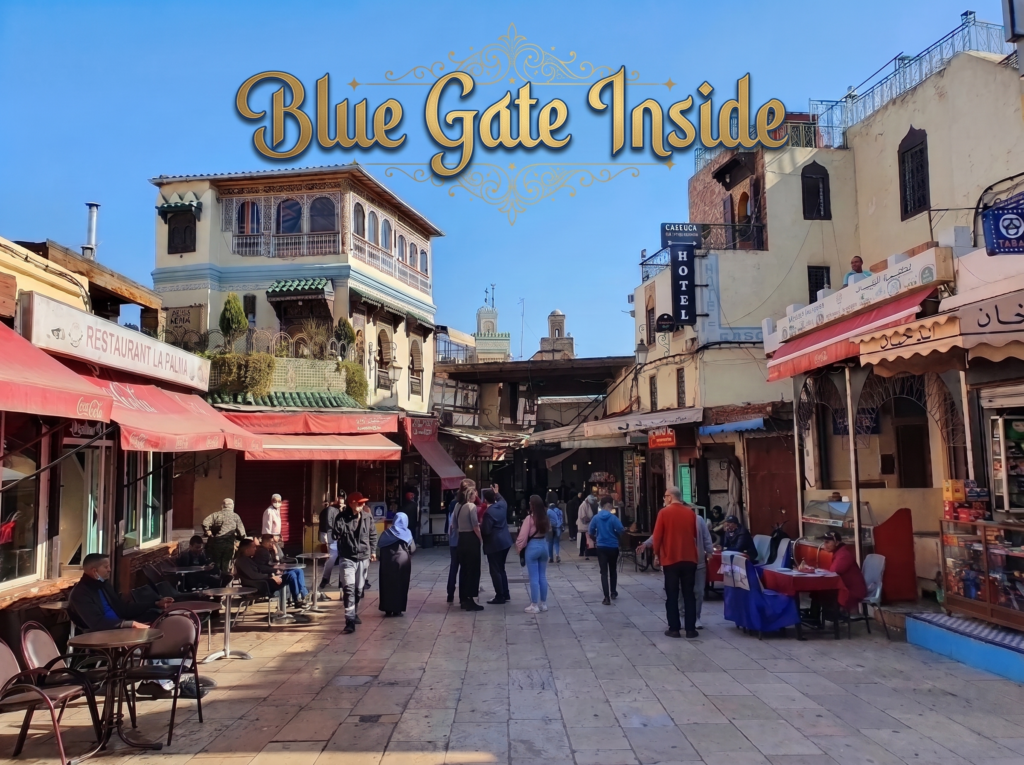
Place Boujloud feels open and animated, while passing through the gate brings you into the medina’s narrower pedestrian streets. The change in pace is clear as the broad square gives way to close-set buildings.
Local people, vendors, tour groups, and visitors move through the square for different reasons. Cafes and restaurants inside and around the gate give you places to pause for food or a drink.
Cafes and meals by Place Boujloud
Cars stop outside the medina after the gate, and pedestrian movement takes over beyond it. That shift leaves the square as a lively meeting place before you enter the busy lanes.
The cafes and restaurants suit a slower break between walks. You can sit near the square, watch people come and go, and decide how long to stay.
A visitor in February 2026 praised the area’s cultural and traditional character and its lively evening atmosphere. That is one person’s impression, not a promise that every visit will feel the same.
The change from the square to the medina
Inside the entrance, the streets feel tighter and more enclosed than the open approach. People on foot share the lanes with shopkeepers and vendors carrying goods through the old medina.
Another visitor treated the gate as a beautiful but brief photo stop. Your own visit can be quick too, or you can use the square as a starting point for a meal and a longer walk.
The nearby cafes offer a useful pause after time among the lanes. Their presence also means the entrance area stays active beyond the moment you take a picture.
Expect the square to feel like a busy meeting place rather than a quiet monument.
How do you get to Bab Boujloud from elsewhere in Fez?
Walking is a straightforward option from nearby parts of Fez, while a taxi makes sense from farther away. The best choice depends on where you start and whether your trip includes other stops.
A taxi ride from Ville Nouvelle takes a matter of minutes, and the ride from Fes el-Jdid is shorter. Guided tours commonly include a stop at Bab Boujloud, often with transfers.
Consider these four ways to reach the western entrance:
- Walk from a nearby area if the distance suits your plans.
- Take a taxi from Ville Nouvelle for a brief ride across the city.
- Take a shorter taxi ride from Fes el-Jdid.
- Join a guided tour that includes the gate and transfers.
Walking can make sense if you are already close to the old medina. It also lets you see more of the city on the way, though the route depends on your starting point.
From Ville Nouvelle, a taxi is a simple way to reach the square without walking across town. The trip takes a matter of minutes, but traffic can affect the ride.
Fes el-Jdid is closer to the entrance, so a taxi ride from there is shorter. Tour transfers can also help if the gate is one stop in a full-day plan.
Agree on the drop-off point with your driver so you arrive at the entrance rather than expecting a car to continue into the medina.
What does Bab Boujloud’s name reveal about its role?
Bab means “gate” in Arabic, while the rest of Bab Boujloud’s name is commonly linked to Abu al-Junud, or “father of the troops.” The traditional explanation connects the name with a former military parade ground outside the entrance.
The open space in front of the gate fits that account of its setting. The proposed name origin is common, but it is not a confirmed record of the builders’ intent.
In the commonly offered derivation, Bab Boujloud is a popular corruption of Abu al-Junud. The phrase means “father of the troops,” a name tied to the military use of the area.
The name’s first part is easier to state with confidence: bab means gate. That word appears in Arabic place names and describes the role of an entrance or passage.
Bab Boujloud and its surroundings form a threshold to the old medina, which dates back to the Middle Ages. The square gives you an open approach before the enclosed streets begin.
The name helps explain how people have understood the entrance and its setting. It does not establish who chose the name or what the gateway’s planners meant by it.
Read the name as a traditional explanation of the entrance’s setting, not as a confirmed account of its builders’ intentions.
Conclusion
Bab Boujloud is both a striking landmark and a practical starting point for exploring Fes el-Bali. Its broad arches give you a clear place to pause before the medina’s close, winding streets.
An early visit gives you a calmer look at the buildings and the square. Walk through the entrance, then turn back once to see the green face from the medina side.
You can keep the stop brief or stay for a meal and nearby sights. Set aside time for an early visit, then choose one of the medina’s main streets and begin exploring.
FAQ
What does “bab” mean in Moroccan place names?
“Bab” means “gate” in Arabic, as in Bab Boujloud, the entrance to Fes el-Bali. The word describes a passage through a wall or a way into an area. You will see it in other Moroccan place names too. At Fez’s famous gateway, the name points directly to its role as a threshold into the old medina.
How much time should I set aside for a visit to the gate area?
Set aside about 20-40 minutes for the square, a few photos, and a walk through the entrance. That gives you time to see both faces and take in the movement around Place Boujloud. Allow longer if you plan to stop for a meal or visit nearby landmarks. A quiet early visit can be shorter, while a busy square may slow your walk.
What is the difference between Fes el-Bali and Fes el-Jdid?
Fes el-Bali is Fez’s older medina, while Fes el-Jdid is a smaller, more recent part of the city. Bab Boujloud stands at the western entrance to Fes el-Bali. The two names help you tell parts of Fez apart when planning a walk or taxi ride. Both belong to the city, but they have different histories and street settings.
Can I visit Bab Boujloud without joining a tour?
Yes, you can walk through Bab Boujloud for free at any hour without joining a tour. The entrance is a public passage, so you can visit on your own and choose how long to stay. A guide is optional and can help you explore beyond the gate or understand the medina’s winding lanes. You do not need a tour to see the gateway itself.
Are shops open if I visit the medina at sunrise?
No, shops have not opened yet during the quiet early-morning period around sunrise. That time works best if you want to see the buildings and streets with fewer people around. Plan to return later if shopping is part of your visit. The early calm offers a different view of the medina, but it is not the time to browse its stores.
Is the older gate beside Bab Boujloud the entrance visitors use today?
No, the older gate beside Bab Boujloud is closed, and visitors use the monumental 1913 entrance. Viewed from Place Boujloud, the older passage stands to the left of the current gateway. Its bent route once led people sideways into Tala’a Kebira. Today, it remains a separate historic feature rather than an active way into Fes el-Bali.